
For conventional industrial furnaces, Ceramic Fiber Board containing organic binders remains a mature and widely used option. During initial heat-up, the organic components gradually burn out, and the temporary smoke and odor generated during this process can generally be managed through preheating and adequate ventilation.
However, for equipment where initial heat-up emissions, furnace-chamber conditions, and the fabrication of custom insulation components are more critical, the bonding system becomes an important consideration in material selection.
CCEWOOL® Inorganic Ceramic Fiber Board uses an inorganic bonding system without conventional organic binders. This helps reduce smoke, odor, and related volatile emissions associated with organic binder burnout while maintaining a stable board structure suitable for subsequent Fabrication.
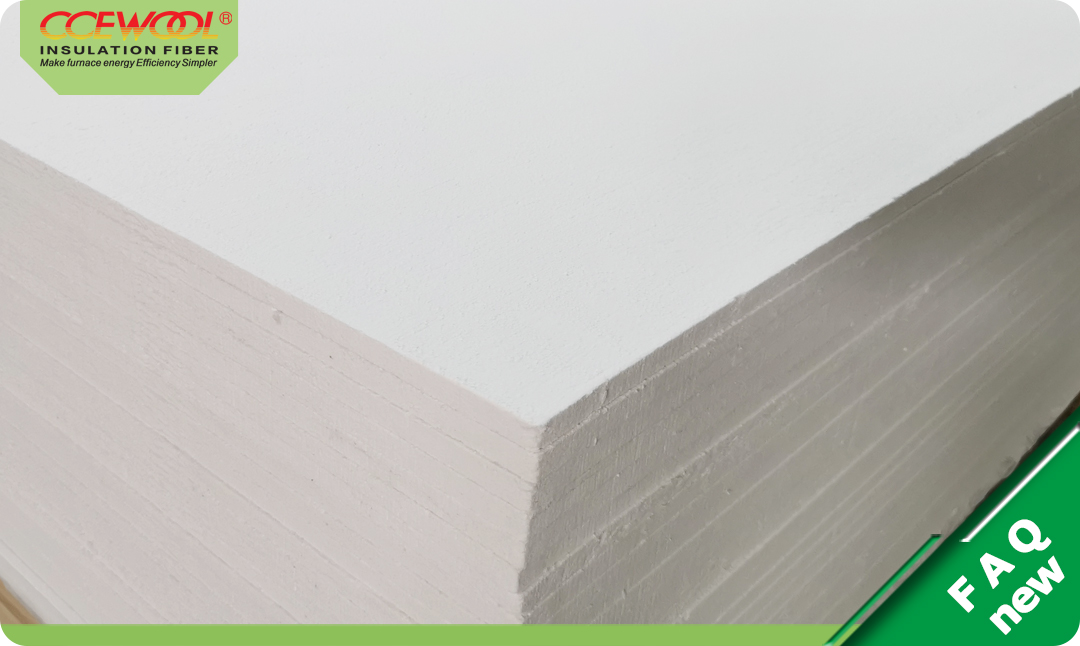
Inorganic Bonding System Reduces Emissions from Organic Binder Burnout
Conventional Ceramic Fiber Board typically contains a certain proportion of organic binder to provide the required room-temperature bonding strength and forming performance.
During initial equipment heat-up, these organic components gradually undergo thermal decomposition, oxidation, and burnout as the temperature rises, potentially producing temporary smoke, odor, and volatile substances.
For conventional industrial furnaces, this process can generally be managed through preheating, ventilation, and controlled heat-up procedures.
CCEWOOL® Inorganic Ceramic Fiber Board does not use conventional organic binders and therefore does not undergo organic binder burnout within the board itself. This helps reduce the associated smoke, odor, and volatile emissions and can also reduce the corresponding requirements for preheating and exhaust ventilation.
It is important to note that an inorganic-bonded board does not mean that the entire equipment system will produce absolutely no smoke or emissions during heat-up. Coatings, sealing materials, machining residues, and other components may also release volatile substances as temperatures rise.
The key advantage of an inorganic ceramic fiber board is therefore its ability to reduce initial heat-up emissions specifically associated with organic binders in the board.
Controlled Forming and 2-Hour Rapid Deep Drying Improve Board Consistency
Because inorganic ceramic fiber board must maintain a stable room-temperature structure without relying on conventional organic binders, fiber distribution, forming control, the inorganic bonding system, and the drying process all influence the final board quality.
CCEWOOL® Inorganic Ceramic Fiber Board uses controlled fiber distribution, forming, and an inorganic bonding system to achieve a more uniform internal structure. A 2-hour rapid deep-drying process is then applied to promote more complete moisture removal throughout the board.
More thorough drying helps maintain consistent surface condition, thickness, and overall structural stability while reducing variation between different areas of the board and between production batches. This provides a more consistent base material for subsequent cutting, CNC machining, custom Fabrication, and installation.
Uniform and Stable Board Structure Improves Fabrication Performance
CCEWOOL® Inorganic Ceramic Fiber Board combines controlled forming, an inorganic bonding system, and thorough drying to create a more uniform internal structure with consistent surface condition and dimensional stability.
For customers requiring cutting, drilling, grooving, chamfering, CNC machining, or custom-shaped Fabrication, this stable board structure helps maintain board integrity and edge condition during processing while reducing machining variation caused by local structural inconsistencies.
This is particularly valuable for batch production of identical insulation components. More consistent thickness, density, and board condition help improve repeatability between fabricated parts, making downstream Fabrication more controlled and better suited to continuous and high-volume production.
From Standard Boards to Custom Insulation Components
CCEWOOL® Inorganic Ceramic Fiber Board can be used directly as a high-temperature insulation board or further fabricated according to customer drawings into insulation components of different shapes and configurations.
Typical fabricated components include:
● Furnace door insulation panels
● Sight-port insulation components
● Ring-shaped insulation parts
● Grooved components
● Pre-drilled components
● Custom-shaped lining panels
● Other custom high-temperature insulation components
Factory pre-fabrication can reduce on-site cutting and secondary finishing while helping insulation components better match the equipment structure.
For repeated dimensions or batch-produced components, dimensions and machining features can also be controlled according to approved drawings, providing a more consistent basis for subsequent assembly.
CCEWOOL® Inorganic Ceramic Fiber Board for More Demanding High-Temperature Equipment
CCEWOOL® Inorganic Ceramic Fiber Board can be used in laboratory furnaces, heat-treatment furnaces, electronic-component heat-treatment equipment, precision thermal-processing systems, and other high-temperature equipment with higher requirements for furnace-chamber conditions and custom insulation components.
In industries such as electronics manufacturing, precision materials processing, laboratory equipment, and industrial heat treatment, the product can be used for furnace walls, roofs, doors, access openings, and custom-fabricated insulation components.
The key value of CCEWOOL® Inorganic Ceramic Fiber Board is not simply that it is “smoke-free.” Its inorganic bonding system, controlled forming process, and 2-hour rapid deep-drying process help reduce initial heat-up emissions associated with organic binder burnout while providing a stable base material for subsequent Fabrication.
CCEWOOL® can provide different temperature grades, thicknesses, densities, and dimensions according to equipment temperature, structural requirements, and installation conditions. Cutting, Drilling, Grooving, Chamfering, CNC Machining, and other forms of Custom Fabrication are also available.
For high-temperature equipment projects that place greater emphasis on initial heat-up emissions, board consistency, and the fabrication of custom insulation components, CCEWOOL® Inorganic Ceramic Fiber Board provides a more application-focused insulation solution.
Post time: Sep-16-2026
