
Many engineers assume that a back-up insulation layer only needs to provide thermal insulation. However, in industrial furnaces operating at elevated temperatures for extended periods, the thermal conductivity, dimensional stability, and long-term shrinkage behavior of the back-up layer can directly affect shell temperature, energy consumption, and maintenance intervals.
In many insulation systems, this perspective often overlooks the real reason why 1900°F Ceramic Fiber Board is selected.
For most industrial furnace applications, the back-up layer is not directly exposed to the furnace atmosphere. As a result, the actual performance of the insulation system is often determined more by thermal conductivity, dimensional stability, and long-term lining integrity than by temperature classification alone.
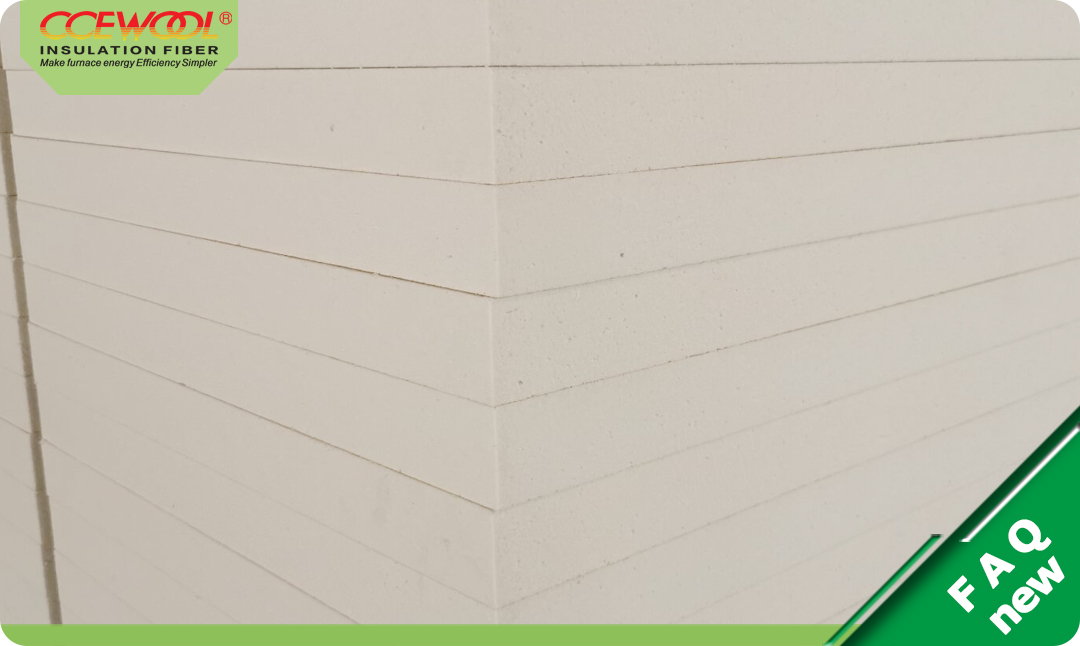
Higher Temperature Rating Does Not Tell the Whole Story
The back-up layer serves a different purpose from the hot-face lining.
Its primary functions are to:
- Reduce heat transfer
- Protect the furnace shell
- Support the long-term stability of the lining system
For this reason, engineers evaluating back-up insulation materials often focus on thermal conductivity and shrinkage performance rather than temperature rating alone.
When a new lining system is installed, most insulation products can initially achieve the required thermal performance. However, under prolonged high-temperature service, conventional ceramic fiber boards may gradually shrink.
As shrinkage occurs, gaps can develop within the lining structure, allowing heat to penetrate behind the hot-face lining and create localized heat leakage.
Over time, this may result in:
- Higher shell temperatures
- Localized hot spots
- Increased energy consumption
- More frequent maintenance requirements
This is why experienced furnace engineers evaluate not only initial insulation performance, but also long-term dimensional stability.
Why Do Some Engineers Choose 1900°F Ceramic Fiber Board?
The selection of 1900°F Ceramic Fiber Board is typically driven by performance requirements rather than temperature classification alone.
Lower Thermal Conductivity
Within the temperature range commonly experienced by back-up insulation layers, 1900°F Ceramic Fiber Board often provides lower thermal conductivity than conventional ceramic fiber boards.
This helps:
- Reduce heat loss
- Lower shell temperature
- Improve overall furnace energy efficiency
Improved Dimensional Stability
Long-term shrinkage can directly affect lining integrity.
For furnaces expected to operate continuously for years, many engineers consider dimensional stability to be a critical performance indicator.
Improved stability helps minimize gap formation within the lining system and supports more consistent insulation performance over time.
Potential for Reduced Lining Thickness
In some furnace designs, available installation space is limited.
Because of its lower thermal conductivity, 1900°F Ceramic Fiber Board may allow the required insulation performance to be achieved with a thinner back-up layer, providing greater flexibility in lining design.
Designed for High-Performance Back-Up Insulation
CCEWOOL® 1900°F Back-Up Board is specifically designed for applications where minimizing heat loss and maintaining long-term lining integrity are key priorities.
Its performance advantages help support:
- Lower heat loss
- Improved energy efficiency
- Reduced shell temperatures
- Enhanced long-term lining reliability
When Is 1900°F Ceramic Fiber Board the Right Choice?
1900°F Ceramic Fiber Board is particularly suitable for industrial furnaces that operate at elevated temperatures for extended periods and require tighter control of shell temperature, heat loss, and long-term lining performance.
Typical applications include:
- Walking Beam Reheating Furnaces
- Reheat Furnaces
- Petrochemical Heaters
- Continuous Process Furnaces
- High-Temperature Industrial Heating Equipment
In these systems, the back-up layer experiences thermal loading over long operating cycles.
Conventional insulation boards may gradually shrink over time, creating gaps that contribute to localized heat leakage.
CCEWOOL® 1900°F Back-Up Board can be used in these back-up insulation layers to help maintain more stable insulation performance throughout long-term service.
More Than a Higher Temperature Rating
For industrial furnaces where heat-loss reduction, shell-temperature control, and long-term lining stability are critical, CCEWOOL® 1900°F Back-Up Board provides a valuable back-up insulation solution.
Its value lies not simply in a higher temperature rating, but in:
- Lower thermal conductivity at elevated temperatures
- Improved dimensional stability
- Better long-term lining integrity
When projects require more reliable back-up insulation performance, or when lining thickness is limited by existing furnace structures, CCEWOOL® 1900°F Back-Up Board provides dependable thermal insulation support for long-term furnace operation.
Post time: Jun-05-2026
