
Therefore, the lining of an aluminum melting furnace should not be designed around a single temperature grade or one product throughout the entire furnace. Instead, materials should be selected by zone according to the actual operating conditions of each area.
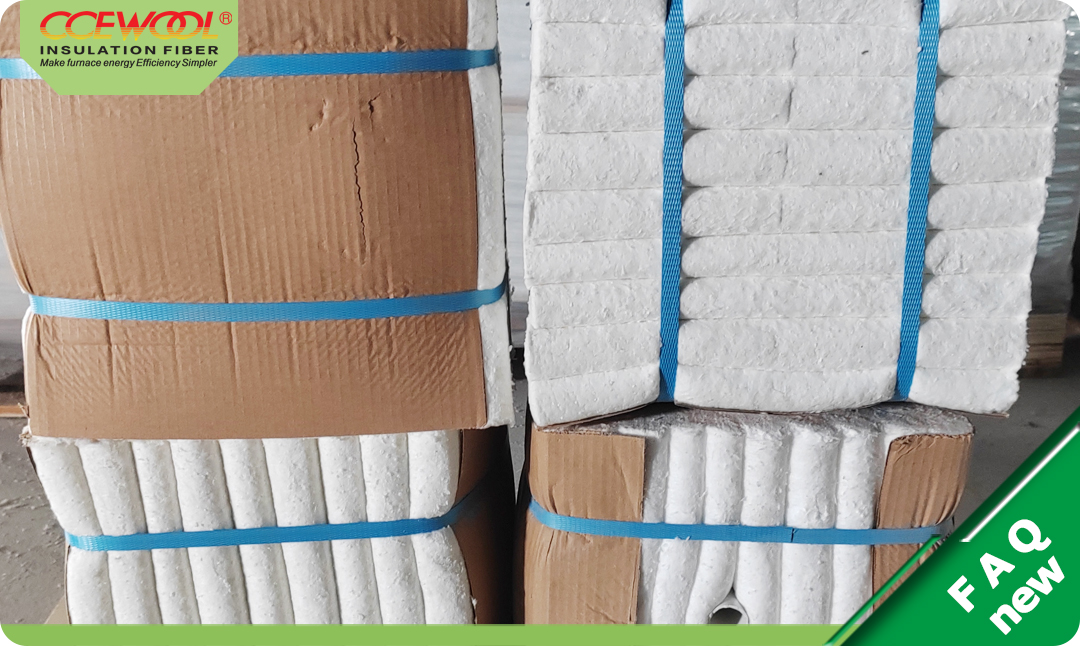
CCEWOOL® Ceramic Fiber Modules are primarily used in high-temperature insulation areas that are not continuously exposed to direct contact with molten aluminum. The appropriate product grade and lining structure should be determined based on the temperature profile, furnace atmosphere, gas velocity, anchoring method, and overall lining design.
Furnace Roof: Reducing Heat Storage and Radiant Heat Loss
The furnace roof is continuously exposed to high-temperature furnace gases and radiant heat, making it one of the higher thermal-load areas of an aluminum melting furnace.
Compared with dense refractory linings, Ceramic Fiber Modules have lower bulk density and heat-storage capacity, helping reduce the amount of heat absorbed and stored by the roof lining while limiting heat transfer toward the furnace shell.
The hot-face temperature is typically around 1100°C, with higher local temperatures possible under certain operating conditions. For roof areas exposed to higher thermal loads, a zirconia-containing CCEWOOL® Ceramic Fiber Module may be selected to provide additional temperature margin under prolonged exposure to high-temperature furnace gases and radiant heat. Alternatively, the appropriate module grade can be selected according to the actual operating temperature.
Ceramic Fiber Modules use a pre-compressed structure. When proper module compression, layout, and installation quality are maintained, fiber recovery after installation helps keep adjacent modules tightly compressed against one another, thereby reducing localized thermal bridges caused by open joints.
Therefore, roof design should consider not only temperature rating, but also low heat storage, high-temperature insulation, joint control, and furnace-shell temperature management.
Upper Furnace Walls Above the Metal Line: Reducing Outward Heat Transfer
The upper furnace walls are primarily exposed to high-temperature furnace gases and radiant heat. Their operating conditions differ significantly from those of the lower walls that are in direct contact with molten aluminum.
For upper walls that are not continuously exposed to molten aluminum, the typical hot-face temperature is around 1100°C. Depending on the actual operating temperature, a CCEWOOL® 1260°C Ceramic Fiber Module or a higher-temperature-grade module may be selected.
For large wall areas, the modular lining can be installed continuously according to the furnace dimensions to form a lightweight and relatively continuous high-temperature insulation layer. Rather than simply selecting the highest available temperature grade, a more appropriate approach is to consider the actual wall temperature, lining thickness, hot-face conditions, and required service life.
This helps meet insulation requirements while avoiding unnecessary cost caused by specifying a product grade higher than the application requires.
Furnace Doors and Charging Openings: Adapting to Frequent Thermal Cycling
Furnace doors and charging openings operate in a high-temperature furnace environment of approximately 1000°C and are frequently opened and closed, making them areas subject to significant temperature fluctuations and thermal cycling.
When the door is opened for charging, cooler ambient air rapidly enters the furnace. Once the door is closed, the lining is again exposed to high-temperature furnace gases and radiant heat.
The main insulation area of the furnace door can use CCEWOOL® Ceramic Fiber Modules selected according to the actual operating temperature, while door frames, moving interfaces, and complex joints can be combined with Ceramic Fiber Blanket and Ceramic Fiber Rope.
The Module primarily provides high-temperature insulation across the main door area; Blanket can be used for backup insulation, local filling, and structural transitions; and Rope is better suited to door frames, moving interfaces, and locations requiring compressible sealing.
This combination is not simply the use of multiple products together. Each product performs a specific function—main-area insulation, local filling, or flexible sealing—to better accommodate the repeated opening and closing of the furnace door.
Burner Areas: Managing Higher Local Thermal Loads
Burner areas operate under substantially different conditions from ordinary furnace walls.
Direct flame, high-temperature combustion gases, high-velocity flow, and concentrated radiant heat can create significantly higher local thermal loads around the burner zone, with temperatures reaching approximately 1250°C.
Depending on the actual operating temperature, a higher-temperature-grade Ceramic Fiber Module, such as a CCEWOOL® 1430°C Ceramic Fiber Module, may be selected. However, Ceramic Fiber Modules should not simply replace the refractory working lining at burner outlets that are directly exposed to flame impingement and high-velocity gas erosion.
Areas subject to direct flame or strong gas-flow erosion generally require Burner Blocks, Refractory Castables, Dense Refractory Bricks, or other suitable refractory working linings.
Ceramic Fiber Modules are more appropriately used around these refractory working linings in high-temperature insulation zones that are not directly subjected to severe mechanical erosion. Ceramic Fiber Blanket can also be used at interfaces and structural transition areas for sealing.
This layered arrangement allows refractory materials to withstand direct flame and mechanical attack, while fiber modules perform the high-temperature insulation function for which they are better suited.
Flue and Exhaust Areas: Maintaining Continuity of the Insulation System
High-temperature flue gases from the aluminum melting furnace pass through the flue and exhaust system, where continuous heat transfer also occurs. However, flue temperature, gas velocity, and structural configuration can vary considerably from one system to another, so it is not appropriate to specify a single temperature grade or one insulation product for all flue areas.
Close to the furnace and before the flue gas enters a heat-recovery system, temperatures may reach approximately 800–1100°C. Ceramic Fiber Module, Ceramic Fiber Blanket, or other fiber insulation systems can be selected according to the actual flue-gas temperature and structural configuration.
Regular, large-area sections can use Modules to form a continuous insulation layer, while elbows, interfaces, expansion joints, sight ports, door frames, burner connections, and other complex areas can be supplemented with Ceramic Fiber Blanket, Rope, or Bulk for backup insulation, filling, and compression sealing.
This approach—using modular insulation in regular areas and flexible fiber products at complex joints and transitions—helps reduce localized thermal bridges and maintain continuity throughout the insulation system.
Design the Lining by Operating Zone Rather Than Using One Product Throughout the Furnace
The key to applying CCEWOOL® Ceramic Fiber Modules in an Aluminum Melting Furnace is not to use one module type or one temperature grade throughout the entire furnace, but to design the lining according to the operating conditions of each zone.
The furnace roof mainly requires control of high-temperature radiation, heat storage, and furnace-shell temperature. Upper walls require continuous insulation and stable large-area lining construction. Furnace doors and charging openings must accommodate thermal cycling and flexible sealing at moving interfaces. Burner areas must account for higher local thermal loads, direct flame, and high-velocity gas flow. Molten-aluminum contact zones, meanwhile, require refractory working linings specifically designed to resist molten metal attack.
CCEWOOL® Ceramic Fiber Blanket, Board, Paper, Rope, and Bulk can also be incorporated into the overall lining system for backup insulation, gap filling, joint treatment, expansion compensation, and sealing around complex structures.
For an aluminum melting furnace, effective lining design is not simply a matter of selecting the highest temperature rating. Refractory working linings should withstand molten aluminum penetration, corrosion, and mechanical attack, while Ceramic Fiber Modules should provide lightweight, high-efficiency insulation in suitable areas. Other ceramic fiber products can then be used to address complex joints, transitions, and sealing requirements.
This zoned lining approach allows the advantages of CCEWOOL® Ceramic Fiber Modules—including low heat storage, high-temperature insulation, modular installation, and flexible maintenance—to be used more effectively in Aluminum Melting Furnace applications.
Post time: Sep-16-2026
