
In industrial furnaces, high-temperature pipelines, and thermal insulation systems, ceramic fiber blankets are widely used as lightweight insulation materials. However, many users find during operation that the blanket gradually becomes brittle, sheds fibers, or even powders. This leads to a reduction in insulation thickness, instability of the lining structure, and increased energy consumption.
So why does a ceramic fiber blanket powder? The root causes mainly come from two aspects: impurity content in the raw material system and the way the fiber structure is formed
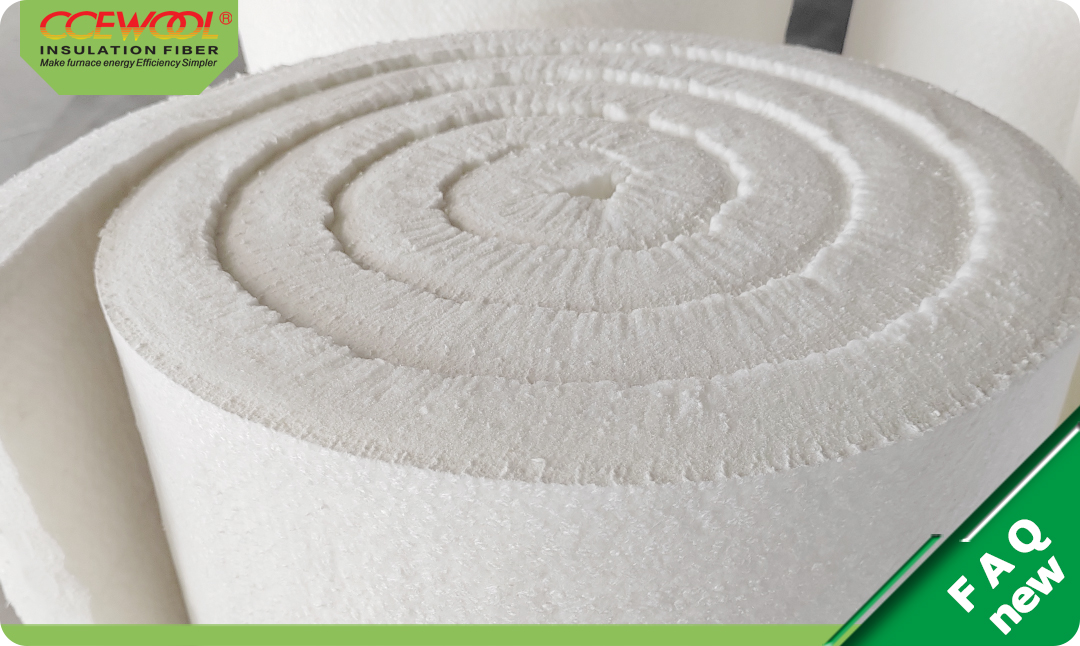
Why doesn’t the CCEWOOL® Ceramic Wool Blanket powder?
The CCEWOOL® ceramic wool blanket eliminates powdering at the source through two core technologies: higher-purity raw materials and a more stable fiber structure.
Impurity content controlled to ≤1%, significantly improving structural stability
CCEWOOL® ceramic wool blanket operates its own raw material bases, enabling strict control of purity from the very beginning. Through refined grading processes and rigorous incoming material inspection, impurity content is consistently kept below 1%. This ultra-low impurity level brings several key advantages:
-
No abnormal grain growth, no fiber embrittlement
High-purity alumina and silica stabilize the glass phase, allowing fibers to remain flexible under repeated high-temperature cycles instead of becoming brittle and powdering. -
Lower linear shrinkage, more stable fiber structure
Fewer impurities mean fewer abnormal crystalline phases at high temperatures, helping the ceramic fiber blanket maintain its full thickness without loosening or shedding. -
A continuous and intact fiber network over long-term use
Fibers do not break or disintegrate, naturally preventing powdering.
Proprietary double-sided internal needle-punching process prevents powdering structurally
Beyond raw material purity, the structural stability of a ceramic fiber blanket plays a decisive role in whether it powders.
CCEWOOL® ceramic wool blanket uses a self-developed double-sided internal needle-punching process, which deeply interlocks fibers through the thickness of the blanket. This gives the ceramic wool blanket:
-
Higher tensile strength, reducing breakage and powdering
Multi-directional fiber interlocking forms a tough, integral structure, with tensile strength consistently exceeding 75 kPa. -
Stronger tear resistance, no loosening during service
Even under mechanical vibration and thermal shock, the blanket maintains integrity and does not start powdering from the edges. -
Greater structural stability with no collapse or shedding at high temperatures
Uniform, deep needle punching tightly bonds fibers together, allowing the blanket to retain its full thickness during long-term operation.
Powdering of ceramic fiber blankets is not accidental—it is the combined result of excessive impurities and insufficient structural stability.By keeping impurity content consistently below 1% to ensure crystal-phase stability, and by applying its proprietary double-sided internal needle-punching technology to significantly enhance tensile strength and structural integrity, CCEWOOL® ceramic wool blanket ensures that its ceramic wool blankets remain non-powdering, non-deforming, dimensionally stable, and thermally efficient even under long-term high-temperature operation. This provides industrial furnace systems with a more reliable and longer-lasting insulation solution.
Post time: Dec-15-2025
