
In high-temperature insulation systems, ceramic fiber blankets must endure long-term exposure to high-temperature heat flux, mechanical vibration, frequent thermal shock, and furnace loading. Ordinary ceramic fiber blankets, due to their high impurity content, often experience the following issues:
- High slag ball content and short fibers: Brittle and easily broken fibers lead to powdering, slag shedding, and thickness attenuation.
- Unstable thermal conductivity: Slag balls create "thermal bridges," causing insulation performance to deteriorate rapidly as temperature increases.
- Prone to structural collapse or thermal shock cracking: Impurities promote crystal phase instability, causing the material to lose its supporting capacity under repeated thermal cycling.
CCEWOOL® ceramic insulation blanket, through controlled raw materials and production processes, have achieved a breakthrough ≤1% ultra-low impurity content, resulting in a more stable structure and longer service life.The following analysis explains, from a process perspective, how CCEWOOL® achieves such ultra-low impurity content:
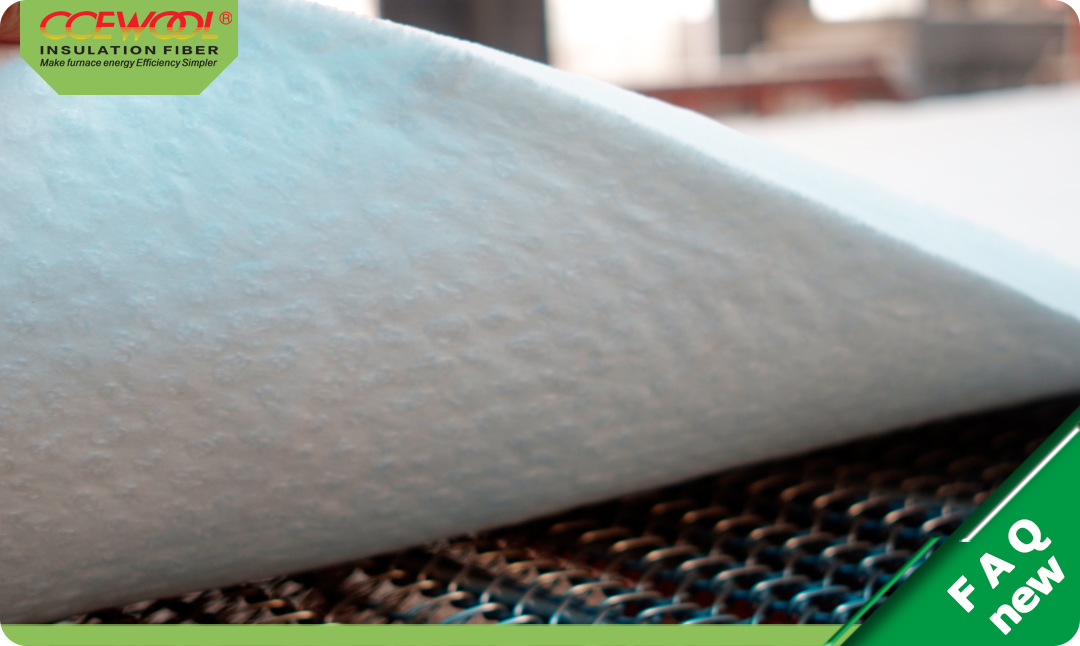
Self-Owned Raw Material Base: Reducing Slag Ball and Short Fiber Risks from the Source
CCEWOOL® ceramic insulation blanket utilizes high-purity raw materials from its own mining sites, which have low low-melting-point impurity content. Automated preliminary screening removes iron and clay dust, ensuring more uniform fiber formation. Lower impurity content minimizes crystal phase disruption, preventing structural degradation at high temperatures. As a result, CCEWOOL® ceramic insulation blanket maintain the following even under continuous operation at 1000–1200°C:
- Fibers remain non-brittle and non-powdering.
- Thermal conductivity does not deteriorate rapidly with temperature.
- Flexibility and strength are preserved after thermal shock.
The low impurity content of CCEWOOL® ceramic insulation blanket directly contributes to more stable heat resistance, making them more "heat-resistant, thermal-shock-resistant, and vibration-resistant" under high-temperature impact.
Deep Calcination: Reducing Impurities and Achieving Lower Linear Shrinkage
Uncalcined raw materials contain a significant amount of volatile impurities, which can transform into slag balls during fiber formation. CCEWOOL® employs high-temperature rotary kiln deep calcination, achieving the following through precise temperature control and extended holding time:
- Complete volatilization of low-melting-point impurities (at 1200–1400°C), with impurity content stabilized at ≤1%.
- More stable crystal phases and fewer broken filaments, enhancing the continuity of melt fiberization.
The stable crystal phases and dense fiber network formed after calcination prevent the fiber blanket from shrinking, collapsing, or thinning during long-term high-temperature operation. The low linear shrinkage achieved through deep calcination is key to maintaining the shape and thickness of the fiber blanket at high temperatures.
Patent-Level Intelligent Detection System: Ensuring Every Roll of Fiber Blanket Has Equally "Low Impurity"
To ensure the controllability and consistency of the low-impurity system, CCEWOOL®ceramic insulation blanket has integrated its proprietary "Fiber Micro-defect Detection System Based on Image Recognition Technology V1.0" into the ceramic fiber blanket production line. This system monitors key parameters in real time, including residual impurities, slag ball count and size, fiber fineness and length, fiber network uniformity, fiberization temperature, slag removal efficiency, and the density and thickness of each roll. It automatically adjusts processes based on anomalies, achieving closed-loop quality control. Therefore, CCEWOOL®'s ultra-low impurity content is not accidental but a consistently repeatable process capability for every batch.
Relying on its self-owned raw material base, high-temperature calcination process, advanced fiberization system, and patent-level detection system, CCEWOOL® ceramic insulation blanket stably controls impurity content at ≤1%. This achieves ceramic fiber blankets with truly: lower thermal conductivity, higher durability, longer service life, and greater stability. CCEWOOL® ceramic insulation blanket have become a reliable insulation material choice for applications in steel, petrochemicals, ceramics, glass, and various high-temperature furnace linings.
Post time: Dec-08-2025
