
In the development of industrial high-temperature systems, insulation materials have undergone a significant transition—from stone wool insulation (rock wool insulation) to refractory ceramic fiber. At first glance, this may appear to be a simple product upgrade. However, from a materials engineering perspective, this shift actually reflects continuous advancements in raw material systems, manufacturing technologies, and microstructural control capabilities.
This evolution has enabled high-temperature insulation materials to move from temperature limits of several hundred degrees Celsius to well above 1000 °C, supporting the development of industrial furnaces, heat treatment equipment, and metallurgical systems that operate at higher temperatures with improved thermal efficiency.
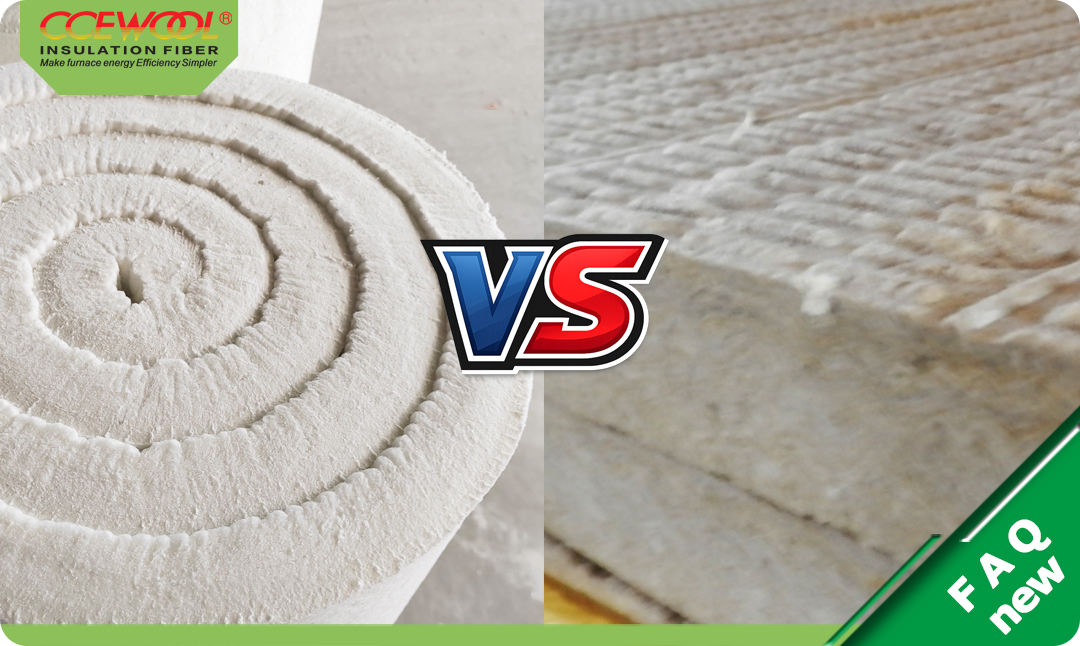
Evolution of Raw Material Systems: From Natural Minerals to Engineered Oxides
CCEWOOL® Stone wool insulation, commonly referred to as rock wool insulation, belongs to the family of mineral fiber products. Its primary raw materials consist of natural mineral systems such as basalt, limestone, and blast furnace slag. During production, these minerals are melted and then converted into fibrous structures through high-speed spinning or blowing processes.
In a typical formulation, stone wool products contain more than 70% natural rock components, with the remaining portion derived from slag and other mineral additives. This raw material system has two fundamental characteristics:
- Complex chemical composition with relatively high impurity levels
- A mineral structure dominated by calcium-magnesium silicate systems
As a result, although rock wool insulation offers good fire resistance and thermal insulation performance, its material structure gradually softens at elevated temperatures. In most industrial environments, the long-term stable operating temperature of stone wool insulation typically remains within the range of 700–850 °C.
As industrial processes continued to demand higher operating temperatures, this natural mineral system gradually became insufficient for more demanding thermal environments.
The introduction of CCEWOOL® refractory ceramic fiber marked a major transition in insulation material raw-material systems. Unlike stone wool insulation, refractory ceramic fiber products are typically manufactured from high-purity alumina (Al₂O₃) and silica (SiO₂).
This engineered oxide system possesses significantly higher melting points and superior chemical stability. Consequently, refractory ceramic fiber insulation materials can operate reliably in environments exceeding 1000 °C and even approaching 1400 °C, depending on the classification temperature of the product.
From a materials engineering standpoint, this transition represents a shift from natural mineral systems to engineered material systems with precisely controlled chemical compositions.
Advances in Manufacturing Technology: From Mineral Fiberization to High-Temperature Melt Fiber Technology
Changes in raw material systems have also driven advancements in manufacturing technologies.
The production process for stone wool insulation is relatively mature. The key steps typically include:
- Melting rock and slag materials at approximately 1500–1600 °C
- Converting the molten material into fibers through high-speed spinning discs or air blowing
- Cooling and collecting the fibers to form wool-like insulation mats
While this process enables large-scale production, the resulting fibers are generally coarser in diameter, and the uniformity of the fiber structure can be limited.
In contrast, the manufacturing of refractory ceramic fiber requires significantly higher temperatures and more advanced processing equipment.
In industrial production, alumina and silica raw materials are melted at temperatures approaching 2000 °C, after which the molten material is converted into fibers through high-speed centrifugal spinning or blowing processes.
This manufacturing approach enables the production of fibers with:
- Smaller fiber diameters
- Higher material purity
- More uniform fiber networks
These characteristics result in several key performance advantages for refractory ceramic fiber materials, including:
- Lower thermal conductivity
- Greater flexibility
- Superior thermal shock resistance
These properties are essential for modern furnace lining systems operating under severe thermal conditions.
Increased Temperature Capability: Material Systems Define Thermal Limits
The temperature capability of insulation materials is fundamentally determined by chemical composition and microstructural stability.
The fiber structure of rock wool insulation is based on a complex silicate glass system. At elevated temperatures, this structure gradually softens and undergoes structural changes. As a result, stone wool insulation is most commonly used in building fire protection systems and medium-temperature insulation applications.
For example, in building fire protection applications, rock wool insulation can withstand fire exposure exceeding 1000 °C without combustion, making it widely used in passive fire protection systems.
However, for industrial environments requiring long-term high-temperature operation, the stone wool material system has inherent limitations.
By contrast, refractory ceramic fiber materials are based on a high-melting alumina–silica oxide system. Through optimization of raw-material purity and microstructural control, the crystallization process at high temperatures can be effectively delayed, enabling the fiber structure to maintain stability under severe thermal conditions.
As a result, refractory ceramic fiber insulation materials typically have classification temperatures ranging from 1100 °C to 1430 °C, allowing them to be widely used in applications such as:
- Metallurgical reheating furnaces
- Heat treatment equipment
- Petrochemical cracking furnaces
- High-temperature industrial kilns
In these systems, refractory ceramic fiber insulation not only reduces furnace lining weight but also significantly lowers heat loss.
The Real Logic Behind the Evolution of High-Temperature Insulation Materials
The transition from CCEWOOL® stone wool insulation (rock wool insulation) to CCEWOOL® refractory ceramic fiber is not simply a matter of replacing one product with another. Rather, it reflects the continuous advancement of high-temperature materials engineering.
Fundamentally, this evolution is driven by three key developments: the transition of raw-material systems from natural mineral compositions to high-purity engineered oxides, the advancement of manufacturing technologies from conventional mineral fiberization to high-temperature melt fiber production, and improved control over material microstructure through composition and process optimization.
Together, these technological improvements have enabled insulation materials to extend their temperature capabilities from several hundred degrees Celsius to well above 1000 °C. This progress has supported the operation of modern metallurgical, heat treatment, and petrochemical systems that demand increasingly higher thermal performance and energy efficiency.
Ultimately, the development of high-temperature insulation materials is not merely a change in product form, but the result of continuous progress in raw material purity, manufacturing technology, and microstructural engineering.
Post time: Mar-16-2026
