
The walking beam reheating furnace is a commonly used billet heating system in the metallurgical industry, mainly applied for heating slabs and billets before rolling. Through the vertical lifting and forward movement of the walking beams, billets are transported through the furnace in a controlled sequence and gradually heated across different temperature zones, ultimately reaching temperatures of approximately 1100–1350°C (2012–2462°F).
Walking beam furnaces operate continuously over long periods and experience wide temperature fluctuations, frequent start-ups, shutdowns, and load adjustments. As a result, the furnace lining materials must meet high requirements in terms of thermal insulation performance, structural stability, and adaptability to operating conditions.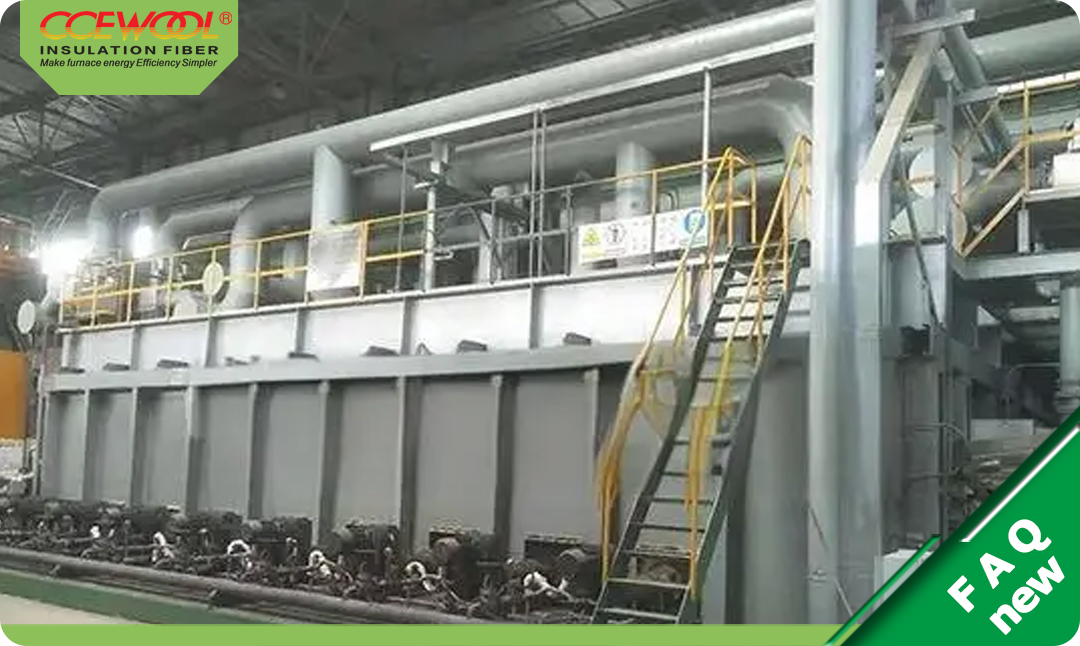
Product Configuration Based on Furnace Temperature Zones
To address the varying service conditions of different furnace areas, CCEWOOL® refractory ceramic fiber products are applied in zoned configurations. By combining ceramic fiber blankets, modules, and structural layers appropriately, a balance between performance and cost efficiency can be achieved.
Furnace Bottom and Areas Below Sidewall Burners
These areas are continuously exposed to high-temperature gas flow and require higher lining strength. A composite structure of CCEWOOL® refractory ceramic fiber boards combined with CCEFIRE® lightweight insulating bricks or castables is typically used, ensuring structural stability while providing effective thermal insulation.
Areas Above Burners and Furnace Roof
The regions above the burners and the furnace roof are where heat is most concentrated in a walking beam reheating furnace and are also critical for reducing energy consumption:
- CCEWOOL® ceramic insulation blanket and fiber modules are used as the primary insulation layers to minimize heat loss.
- In high-temperature hot-face areas above the burners and at the furnace roof, CCEWOOL® PCW fiber modules are selected as the hot-face insulation layer to suppress high-temperature shrinkage and sintering, ensuring long-term lining stability during continuous operation.
- For furnaces with brick linings, an additional CCEWOOL® refractory ceramic fiber insulation layer can be installed to reduce external wall temperatures and shorten retrofit and construction cycles.
Flue Duct Section
Flue ducts operate for extended periods and have large heat dissipation areas, making them a significant source of continuous heat loss. CCEWOOL® ceramic insulation blanket are used to wrap the flue ducts, reducing heat leakage and improving overall thermal efficiency.
Discharge Door Baffles (Fire Curtains)
Under conditions with frequent billet discharge, a flexible baffle system composed of CCEWOOL® refractory ceramic fiber cloth combined with ceramic fiber blankets can be applied. This structure effectively reduces radiant heat loss while remaining lightweight and easy to install and maintain.
In walking beam reheating furnaces, the proper selection of CCEWOOL® refractory ceramic fiber boards, blankets, and modules according to the actual service conditions of each furnace zone helps ensure stable furnace operation, reduce heat loss, and improve overall energy efficiency. These solutions are well suited for continuous production lines and energy-saving retrofit projects.
Post time: Jan-21-2026
